AWS Database Blog
Category: Analytics
Building search experiences for JSON data with Amazon OpenSearch Service
In this post, you learn how to use Amazon OpenSearch Service as a discovery layer that combines full-text, vector, and geospatial search across JSON documents in a single query, using a restaurant discovery app as a working example.
Introducing open source Bulk Executor for Amazon DynamoDB
When using Amazon DynamoDB, you sometimes want to perform bulk operations against all the items in a table, which has historically required custom coding. The open source Bulk Executor for DynamoDB simplifies bulk tasks like these. You can use this feature to invoke commands like count, find, delete, or update. No coding is required, even when running at large scale. In this post, we explore the built-in capabilities of Bulk Executor and show you how to install and use it for common bulk operations against your DynamoDB tables.
Getting started with Change Data Capture in Amazon Aurora DSQL
In this post, we demonstrate how to configure Aurora DSQL Change Data Capture and stream database changes into Kinesis Data Streams. You will learn how CDC works, how to configure a streaming pipeline, and how to consume change events. By the end of this post, you will have a working CDC pipeline that streams database changes into a durable event stream that downstream applications can process.
Filter, transform, and load your DynamoDB table exports using AWS Glue
In this post, we show how you can load (import) an Amazon DynamoDB full or incremental table export into a second DynamoDB table with precise control over what gets loaded, at what write rate, and with the ability to observe the progress. This technique helps drive large-scale data migrations and synchronizations where you want maximum control.
Migrating data from an Amazon Aurora snapshot into Amazon Aurora DSQL
In this post, we demonstrate how to use AWS Glue to migrate data from an Amazon Aurora database snapshot into an Aurora DSQL cluster.
Troubleshoot Amazon RDS for Oracle to Amazon Redshift DMS migrations with AWS DevOps Agent
In this post, we show how you can use AWS DevOps Agent to investigate, identify root causes of, and remediate common AWS DMS issues when migrating from Amazon RDS to Amazon Redshift. DevOps Agent is a Frontier agent that autonomously triages incidents 24/7, providing root cause analysis and recommended actions for resolution based on correlated metrics, logs, and application topology.
AWS purpose-built database recovery: A guide to business continuity and disaster recovery strategies
This post addresses recovery challenges in multi-database architectures, focusing on both low-consistency and mission-critical scenarios. We explore practical strategies for implementing resilient recovery mechanisms across Amazon DynamoDB, Amazon Aurora, Amazon Neptune, Amazon OpenSearch Service, and other AWS database services.
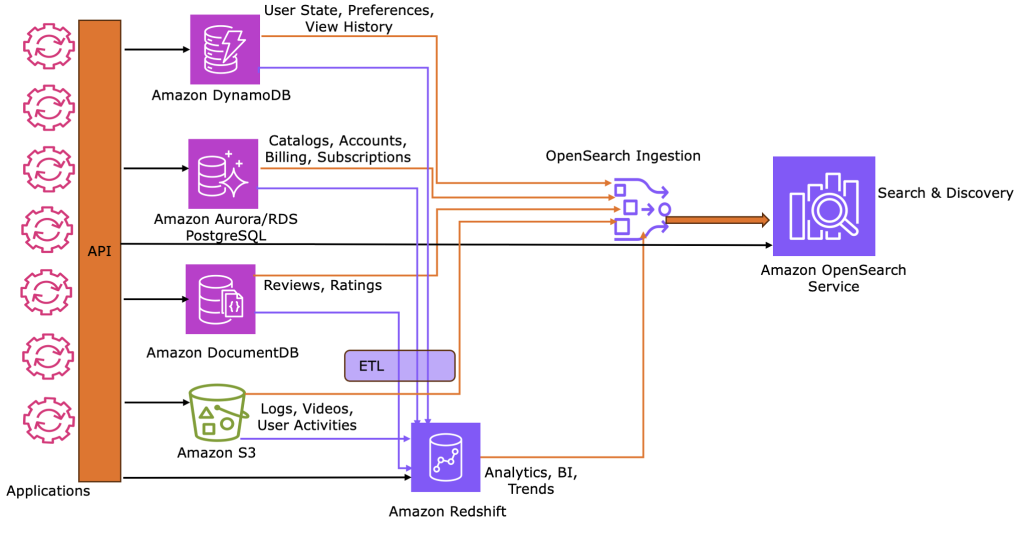
How to build unified JSON search solutions in AWS
Using a movie streaming reference architecture, this post shows how to implement and sync operational, analytical, and search JSON workloads across AWS services. This pattern provides a scalable blueprint for any use case requiring multi-modal JSON data capabilities.
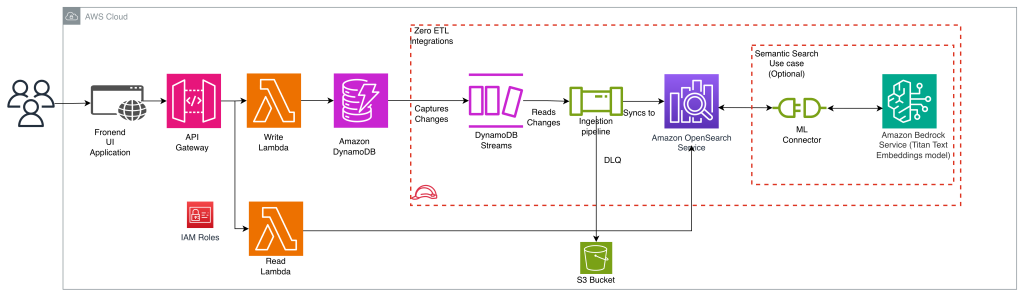
Implementing search on Amazon DynamoDB data using zero-ETL integration with Amazon OpenSearch service
In this post, we show you how to implement search on Amazon DynamoDB data using the zero-ETL integration with Amazon OpenSearch Service. You will learn how to add full-text search, fuzzy matching, and complex search queries to your application without building and maintaining data pipelines.
Optimize LLM response costs and latency with effective caching
In this post, we talk about the benefits of caching in generative AI applications. We also elaborated on a few implementation strategies that can help you create and maintain an effective cache for your application.