AWS Security Blog
Category: Advanced (300)
How to use the AWS Workload Credentials Provider for cross-account secret retrieval and prefetching secrets
If you manage secrets across multiple AWS accounts or need faster secret access for latency-sensitive applications, this post shows you how to meet those requirements using two new features of the AWS Workload Credentials Provider (provider). You will learn how to configure role chaining for cross-account secret retrieval and prefetching of secrets to reduce cold-start […]
Prevent data exfiltration: AWS egress controls for cloud workloads
August 4, 2026: We’ve updated the Data perimeters section. When securing an Amazon Web Services (AWS) environment, teams naturally prioritize inbound controls, firewalls, WAFs, and access policies, because that’s where the most visible threats originate. Outbound traffic, on the other hand, tends to get less attention. It’s often left open by default to avoid breaking […]
Customize federated sign-in with new Amazon Cognito Lambda trigger
You can use Amazon Cognito user pools to add sign-up and sign-in functionality to your web and mobile applications. You can authenticate users directly with Amazon Cognito managed accounts using passwords, passwordless flows, or custom authentication flows, or let users federate in through external identity providers (IdP) using SAML, OpenID Connect, or social providers such […]

Identify unused AWS KMS keys and prevent accidental key deletions
As you scale your use of Amazon Web Services (AWS), managing KMS keys becomes increasingly important. Whether you manage a handful of keys or thousands across multiple AWS accounts and AWS Regions, there’s often a need to audit key usage to help you meet compliance requirements, evaluate your risk posture, and optimize key management costs. […]
Simplifying policy management with URL and Domain Category filtering on AWS Network Firewall
Network administrators face a persistent challenge: maintaining domain blocklists and allowlists that keep pace with the internet. New websites and services emerge daily, and keeping these lists current requires constant manual updates that leave gaps in coverage. This challenge intensifies when managing access to rapidly evolving categories like AI services, where new tools launch on […]
Well-architected best practices for software supply chain security
There have been multiple notable supply chain attacks using the npm Registry since September: Shai-Hulud, Chalk/Debug, one abusing tea.xyz tokens, and recently axios. Thanks to community efforts involving the Amazon Inspector team, the Open Source Security Foundation, and others, the affected packages were quickly flagged, which reduced the impact of these incidents. Supply chain attacks […]
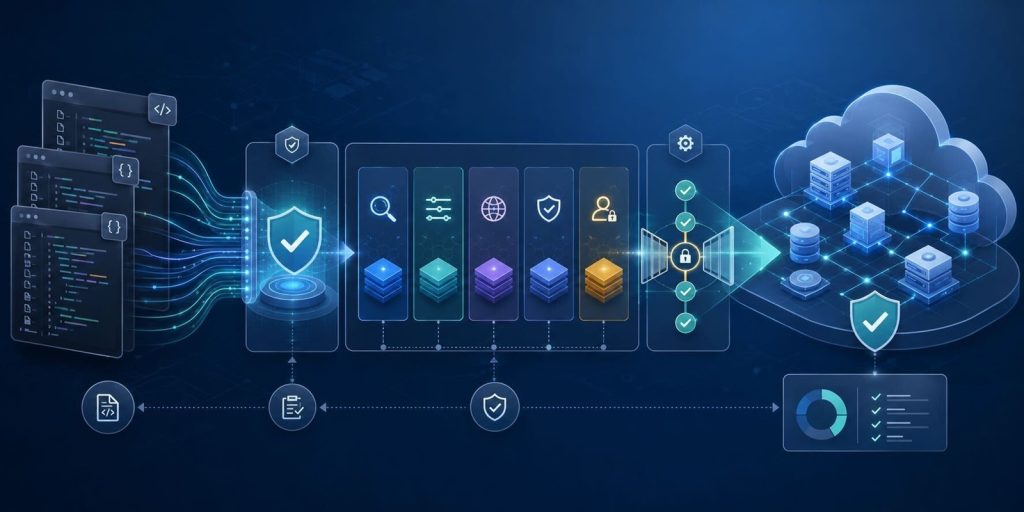
Governing infrastructure as code using pattern-based policy as code
Organizations often struggle to enforce security and compliance requirements consistently across their cloud infrastructure. In one environment, a workload might be deployed in an AWS Region that was never approved for that class of data. In another, a security group might allow broader access than intended. Required tags might be missing. Encryption might be assumed […]

Regional routing for AWS access portals: Implementing custom vanity domains for IAM Identity Center
July 1, 2026: This post has been updated to add support for vanity domains in AWS CLI. AWS IAM Identity Center provides a web-based access portal that gives your workforce a single place to view their AWS accounts and applications. With the recent launch of IAM Identity Center multi-Region replication, customers can replicate their IAM […]
Automating post-quantum cryptography readiness using AWS Config
Migrating your TLS endpoints to Post-quantum cryptography (PQC) starts with understanding your current TLS endpoint inventory and posture. This post introduces the PQC Readiness Scanner — an automated tool that inventories your Application Load Balancer (ALB), Network Load Balancer (NLB), and Amazon API Gateway endpoints and continuously monitors their TLS configurations for PQC readiness. The […]

Five ways to use Kiro and Amazon Q to strengthen your security posture
A Monday morning security alert flags unauthorized access attempts, security group misconfigurations, and AWS Identity and Access Management (IAM) policy violations. Your team needs answers fast. Security teams are using Kiro and Amazon Q Developer to handle repetitive tasks—scanning resources, drafting policies, and researching Common Vulnerabilities and Exposures (CVEs)—so engineers can focus on risk decisions […]