AWS Public Sector Blog
One scan, many findings: Floy’s foundation model platform for opportunistic screening on AWS

Osteoporosis, cardiovascular disease, and neurodegenerative conditions affect tens of millions of Europeans, yet the majority go undiagnosed. Evidence of these conditions is often already visible on routine CT and MRI scans acquired for entirely different clinical questions, at no additional imaging, radiation, or cost. For example, 73 percent of women eligible for osteoporosis treatment in the EU’s six largest markets do not receive it (Borgström et al., Archives of Osteoporosis 2020), largely because formal assessment requires a dedicated dual-energy X-ray absorptiometry (DEXA) scan. Yet bone density loss is measurable on routine scans already being acquired.
These conditions go undetected not because the evidence is absent, but because no systematic process exists to look for them. With MRI exams in Germany alone totaling 13.5 million in 2023 (Eurostat Healthcare Resource Statistics 2023), this gap between what imaging data contains and what gets reported represents a population-scale public health opportunity. Closing it requires AI systems that are accurate, fast, and traceable end to end, not only for research rigor but for the regulatory audit trails mandated under EU MDR Class IIb medical device requirements
Opportunistic screening means analyzing scans already acquired for one clinical question to detect unrelated conditions at no extra cost or radiation to the patient. Making this systematic, in clinical routine, at scale, is the problem Floy was built to solve. Floy is a Munich-based medical AI company whose foundation model (FM)-based platform is deployed across more than 200 radiology practices in Germany, has processed over 100,000 studies, and handles hundreds of new scans daily. The platform returns structured AI reports within 5 minutes of image acquisition, routinely surfacing clinically relevant findings, including aneurysms with a 36.2 percent increased detection rate (Teodorescu et al., Journal of Stroke and Cerebrovascular Diseases 2024) and bone lesions detected 5.7 months earlier than by unassisted radiologists (Fritzsche, M., Kara-Schmidt, P., Kirchler, M., Schroeder, K., Wiedemeyer, C., & Braunschneider, L. E. (2026). Enabling earlier detection of spinal lesions in CT imaging with artificial intelligence—a case study. Frontiers in Artificial Intelligence, 9, 1767814). Built on Amazon Web Services (AWS) and certified up to EU MDR Class IIb, the platform combines large-scale self-supervised pre-training with the elastic, secure infrastructure required for regulated clinical deployment. In February 2025, Floy closed an extended seed round of €9 million.
This post describes how Floy built an FM-based AI platform on AWS, from training and inference to clinical integration, that scales to meet the demands of modern radiology.
The clinical challenge: Opportunistic screening at scale
When a patient undergoes an MRI of the head, the radiologist focuses on answering the referring physician’s clinical question. But the same scan might contain early indicators of Global Cortical Atrophy (GCA), Fazekas-graded white matter lesions, or other findings with significant long-term clinical implications. Catching these routinely, on every applicable study, requires consistent, quantitative analysis that can be difficult for humans to perform reliably under time pressure at volume.
Floy’s medical devices perform exactly this analysis automatically across head, shoulder, breast, thorax/abdomen, and knee imaging, triggered by a single click from the radiology information system (RIS). The platform retrieves applicable prior studies, preprocesses the imaging data, runs it through up to 14 AI models in the cloud, and delivers a structured report without requiring the radiologist to change their workflow.
The scale of this operation demands infrastructure that is simultaneously fast, elastic, cost-efficient, and compliant with stringent European medical device regulations. Floy built this capability on AWS.
Domain-specific foundation models: A platform for clinical AI
The core of Floy’s next-generation head products is an MR Head FM trained on more than 11 million MRI slices drawn from 175,000 head studies. Floy developed the research in collaboration with the German Cancer Research Center (DKFZ) as part of the Human Radiome Project.
Rather than build a separate model from scratch for each clinical question, Floy’s model learns a general understanding of brain MRI across scanners, protocols, and patient populations through self-supervised learning on hundreds of thousands of scans, with no manual annotation. The training method builds on Franca, an extension of the DINOv2 self-supervised learning paradigm, which Floy fine-tuned on large collections of radiology scans. The model learns to produce consistent internal representations from differently augmented views of the same scan, forcing it to capture what is anatomically meaningful rather than superficial pixel patterns.
The resulting Vision Transformer serves as a frozen base on which Floy trains lightweight, task-specific classifiers. The FM itself never changes; only the thin layer on top does. This is what makes the approach a platform rather than a product.
The following diagram illustrates the FM training pipeline.
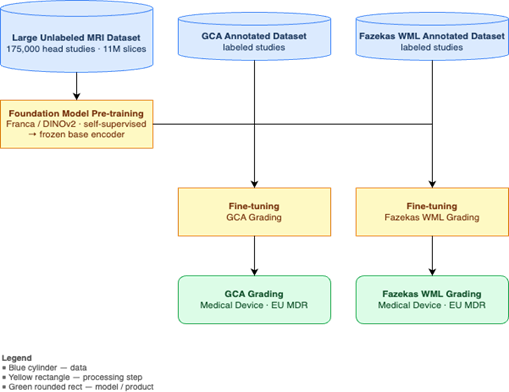
Figure 1: Foundation model training pipeline: A single self-supervised base encoder (center) is fine-tuned into multiple EU MDR-certified medical devices (right) from small annotated datasets (left)
The payoff is both technical and clinical: on internal benchmarks, the approach improved average performance by 3.3 percent and cut training time by roughly 94 percent compared to classical 3D convolutional neural networks. Because the shared base is reused, a new indication can move from research to clinical deployment in a fraction of the time previously required, meaning patients gain access to new detection capabilities sooner.
The MLOps stack: Valohai and AWS
Fast iteration in a regulated environment requires full traceability from annotation to deployment. All data processing, model training, and evaluation runs on Valohai, a machine learning operations (MLOps) platform connected to Floy’s AWS data stores and GPU compute. Valohai operates on a split architecture: its management control plane is a hosted software as a service (SaaS) offering on AWS, and the data and compute plane runs entirely inside Floy’s private AWS account.
Every experiment is fully traceable from data ingestion to final evaluation, a requirement not only for research rigor but for the regulatory audit trails required under EU MDR.
Floy’s team produces training annotations on Encord and exports them directly to Valohai for processing. The development environments use custom Docker images with shared base images across all execution contexts (Valohai training jobs, local devcontainers, and production inference), so the model seen in evaluation is the model that runs in the clinic.
The integration architecture: From PACS to report in 5 minutes
Foundation model performance is necessary but not sufficient for clinical adoption. One of the harder problems is getting AI results into the clinical workflow reliably, automatically, and fast enough to be useful before the radiologist has moved on to the next case.
A single click from the radiologist’s RIS triggers the entire Floy workflow. A local integration component retrieves the new study and applicable prior exams from the Picture Archiving and Communication System (PACS) while acquisition is still underway, adaptively beginning processing as soon as sufficient data is available and reducing wait times by up to 50 percent. A local AI-based filter evaluates more than 30 metadata tags to determine which medical device modules apply.
The pipeline uploads preprocessed Digital Imaging and Communications in Medicine (DICOM) data to Amazon Simple Storage Service (Amazon S3) and hands it off to Floy’s cloud-based pipeline. Fourteen AI models run on GPU-accelerated Amazon Elastic Compute Cloud (Amazon EC2) G5 instances. A custom Amazon Simple Queue Service (Amazon SQS) driven AWS Lambda function automatically scales the fleet based on queue depth and time-based scheduling, scaling to zero overnight for cost-efficiency. Floy deploys additional services as Amazon Elastic Container Service (Amazon ECS) on AWS Fargate tasks, with a Kong API Gateway handling routing and a FastAPI-based backend managing business logic. The full pipeline completes in approximately 5 minutes, with real-time status updates streamed to the clinician throughout.
Amazon Relational Database Service (Amazon RDS) for PostgreSQL stores the processing metadata, including automatically issued Unique Device Identification (UDI) labels and model version numbers for every study, providing the audit trail required under EU MDR.
The following diagram illustrates the solution architecture.
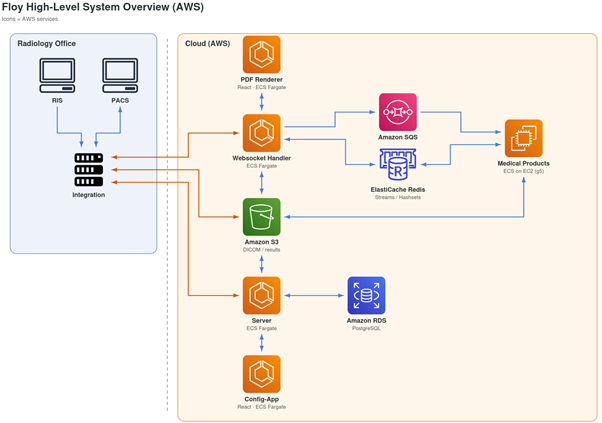
Floy’s AWS infrastructure satisfies EU MDR Class IIb and ISO 13485 requirements at every layer, combining end-to-end encryption, least-privilege access controls, and continuous compliance monitoring.
Looking ahead
Today, Floy’s platform processes hundreds of studies daily across more than 200 radiology practices. To date, it has analyzed more than 100,000 studies, each representing a patient who received systematic opportunistic screening without an additional appointment, scan, or radiation dose.
Floy has already extended its FM approach beyond head imaging. An MR Knee FM now powers automated ICRS grading of cartilage, and the same self-supervised pre-training approach is being applied to bone mineral density products to improve accuracy and accelerate the path to new use cases.
Conclusion
Floy’s FM-based AI platform on AWS scales to meet the demands of modern radiology, supporting a pipeline from training and inference to clinical integration.
To learn more about how AWS supports healthcare and life sciences organizations, visit AWS Health. To explore how Floy is transforming radiology with opportunistic screening, visit floy.com.
To learn more about how other imaging HealthTechs are using AWS, check out the following resources:
- Icometrix helps to detect and treat neurological diseases with AI imaging, powered by AWS
- How CIMAR’s platform enables a national lung cancer screening program at scale, powered by AWS
- Polish healthcare leader Radpoint transforms medical imaging for millions using AWS
- Deploy diagnostic-quality imaging globally with MedDream and AWS HealthImaging